English telly in Thailand, without a VPN or a dish
British and American households in Bangkok, Pattaya, Phuket and Chiang Mai keep asking the same three things: what is on, what time is it on here, and what internet do I need. This is the answer, in baht.
Thailand is one of the easiest places in the world to be an expat with a television habit, and one of the most confusing at the same time. The internet is fast and cheap, the hardware is available everywhere, and the local pay-TV operator will happily sell you a package — but the thing you actually want, which is British or American television in English at a normal hour, is a different question.
Here is what matters, in the order it bites.
The time zones, which decide everything
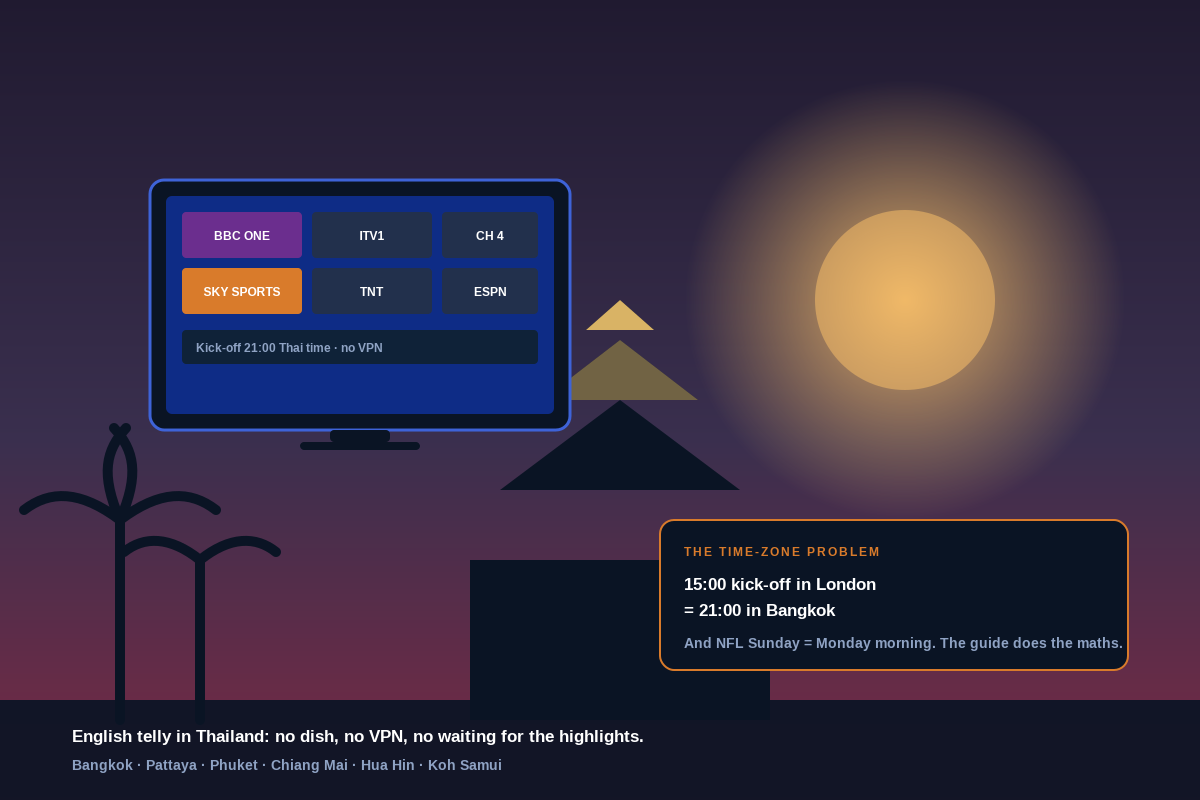
Thailand is UTC+7. Britain is UTC+0 in winter and UTC+1 in summer, so the gap is seven hours for half the year and six for the other half. That produces a broadcast day that looks nothing like the one you left.
| In Britain | In Thailand | What it is |
|---|---|---|
| 12:30 | 19:30 / 18:30 | Saturday lunchtime kick-off — dinner time here |
| 15:00 | 22:00 / 21:00 | The blackout slot: not televised in the UK at all |
| 16:30 | 23:30 / 22:30 | Super Sunday, first match |
| 19:45 | 02:45 / 01:45 | European night — an early-hours job |
| 13:00 ET Sunday | 01:00 Monday | NFL, first window |
| 18:00 PT Saturday | 08:00 Sunday | A Las Vegas fight card — breakfast boxing |
The two Thai times are summer (BST) and winter (GMT) respectively. The guide in your own time zone is what turns this from arithmetic into a schedule — it is the single feature expats use more than any other.
What the internet actually gives you
True, AIS and 3BB all offer fibre in most of the country, and a 500 Mbps package is typically a few hundred baht a month — more than two HD streams will ever need. The bottleneck is almost never the ISP. It is the condo's shared Wi-Fi, the router behind a concrete wall, or a television stick hanging off a USB port.
Practical minimums: 15 Mbps stable for FHD and 25 Mbps for UHD. If you are in a serviced apartment with building Wi-Fi, ask whether you can get your own line — it is usually a few hundred baht a month and it removes most of the complaints before they start.
The local pay-TV question
Thailand has its own licensed operators — TrueVisions being the best known — and they buy the rights that matter to the Thai market: the biggest Premier League matches, some Champions League, and a lot of sport with Thai commentary. It is legitimate, it is cheap, and for a football fan it covers the top games and not the rest.
It will not give you the BBC, ITV, Channel 4, the Ashes with English commentary, or the American networks. That is nothing to do with Thailand; the same is true in Spain and Portugal. Which is why expat households end up with two things: a local package for what is licensed locally, and a channel list for everything else.
What a list does that a VPN does not
A VPN changes where your connection appears to come from. It does not change licensing, it does not give you a UK TV Licence you are entitled to use abroad, and it breaks unpredictably because the broadcasters actively block it. What it certainly does not do is make an American football game appear on a British channel that never had the rights.
A list does something simpler: it carries the international feeds that channels distribute to other territories, alongside the UK shelf and the US channels a mixed household wants. No VPN, no fake postcode, no pretending. The trade-off is that we hold no rights and cannot promise a specific channel exists in a country where nobody carries it — which is exactly why the first day is free.
What it costs, in baht
Thai prices, paid in one sum rather than monthly, with no renewal afterwards. The Home Pass is the one most expat households need — the UK shelf, the football, the catch-up — and the Full House is for households that also want the American feeds and the film archive.
| Pass | Monthly | 24 months, paid once | Best for |
|---|---|---|---|
| Home Pass | ฿150 | ฿3,600 | British households: UK shelf, football, catch-up |
| Full House | ฿225 | ฿5,400 | Mixed households: plus US feeds, films, 4K |
Start with the free day
Twenty-four hours of the complete list, no card, no VPN. Put it through a Sunday night in Bangkok — the 10:30pm kick-off is the honest test — and decide from that.
Get my free 24-hour testQuestions from Thailand
Do I need a VPN to watch UK or US telly in Thailand?
No, and a VPN is not a licence. What you need is a service that carries the international feeds it is able to carry, and a clear idea of what is licensed where you are. Our list is built for that: no VPN, no fake UK postcode, no pretending to be somewhere else.
What internet do I need in Thailand?
Any of the fibre packages — True, AIS or 3BB — comfortably. A 500 Mbps package is typically a few hundred baht a month and is far more than two HD streams need. The weak point is usually the condo Wi-Fi, not the ISP.
Why is the football on so late?
Because Thailand is UTC+7 and Britain is UTC+0 or +1. A 3pm Saturday kick-off is 9pm in Bangkok during British Summer Time and 10pm in winter. Sunday 4:30pm becomes 10:30pm or 11:30pm — which is why Sunday is a late night, not an afternoon.
What about American sport?
The NFL is a Monday-morning sport here: the Sunday 1pm ET window lands at 1am Monday in Thailand. A Las Vegas fight card is Sunday breakfast. The guide in your own time zone is the feature expats use most.
Is this legal in Thailand?
Watching licensed television in Thailand is subject to Thai rules, and to the rights held by the broadcaster in the country of origin. We are not a rights holder and we do not sell a licence — check both before subscribing, and use the free day to see what you actually get.
Keep reading
English telly, Thai prices, no VPN
฿150 a month on the 24-month pass, two screens at once, and twenty-four hours free to check it from your own sofa in Bangkok, Pattaya or Phuket.
Get my free 24-hour test24 months ·
free test first